
By Claire Morrical, TWI Restoration Specialist
This summer, at the Sue and Wes Dixon Waterfowl Refuge, I took a short break from harvesting sedge seeds to harvest cattails. While I’d occasionally snacked on cattails, I was eager to try cooking with them. In a muddy enough spot, you can often pull up an entire cattail shoot and part of its root. Within fifteen minutes, I had a hearty bundle of cattail shoots to cook up for lunch. I peeled off the tough outer layers of the shoot at the base of the cattail, cut up the tender centers, and sautéed them in butter and salt. This is far from the only way to eat a cattail. From the pollen to the roots, I’m excited to try many more recipes! There’s certainly a big enough cattail supply at the Refuge. Cattails are a handy source of food and shelter for wildlife too. We often see muskrat huts made of cattails, and they make a safe hiding spot for marsh wren nests and amphibian eggs. Meanwhile beetles and other insects make a meal out of the plant’s seeds.
I wanted to take this moment to appreciate cattails, specifically the native broadleaf cattail (Typha latifolia) because now I’m going to spend the next thousand or so words talking about how we kill cattails. Despite their value, there is such a thing as too many cattails – especially the more aggressive invasive narrow leaf cattails (Typha angustifolia) and hybrid cattails (Typha x glauca). A good rule of thumb is that when you have a monoculture (a big area of only one species), you also have a problem. Plant and animal communities thrive with diversity. Pockets of different plants provide different services in the community and have different requirements to thrive. (You can learn more about why diversity is important in this blog from The Prairie Ecologist.) Cattails alone are extremely dense. They can close in open areas of wetland and exclude other plant species from growing among them, such as sedges and rushes. This impacts diversity in the plant community and, in turn, deprives wildlife of valuable food sources.
To better understand this problem, let’s start by asking, “How did we get here?” Why are cattails so good at taking over?
I’ll answer that question with another one – What do cattails and Star Wars Episode II have in common?
Clones.
In addition to producing lots of seeds, cattails are rhizomatous, meaning that many cattail shoots can be part of the same genetic individual. They are clones of each other all connected by a robust root system (rhizomes). This root system acts as a reserve for storing nutrients and a highway for sharing them. Come springtime, cattails are poised to grow rapidly and once established, are difficult to kill. Like a hydra with many heads, if you cut one off, more just grow back in its place.
Now that we’ve gotten to know cattails, the good and the bad, how do we manage them at the Dixon Waterfowl Refuge? That’s a question we ask often, with several different answers. As with most things, there’s no one-size-fits-all solution in stewardship. Instead, we have lots of tools in our toolbox for problems, big or small, complex or simple. Let’s look at two sites where we treat cattails at the Refuge.
Site 1: The Hemi-marsh
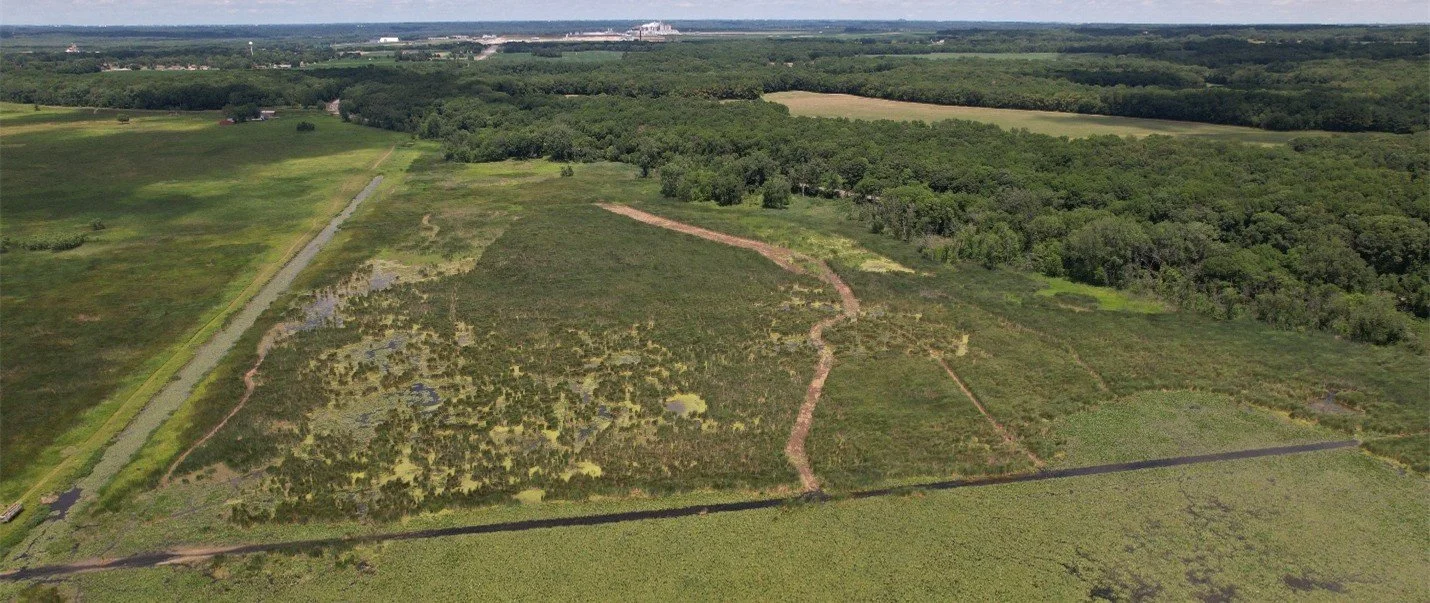
Hemi-marsh at the Sue and Wes Dixon Waterfowl Refuge. In the bottom left corner is our ideal hemi-marsh – a patchwork of water and cattails. Above and to the right of it are dense monocultures of cattails. The brown line is where we rolled cattails with the marsh master in an effort to create areas of open water and allow other species to establish. Credit: Jean McGuire
Extending from the edge of Hennepin Hopper Lake at the Refuge are massive stands of cattails. The soil beneath them is wet throughout the summer and floods seasonally. Other than an occasional patch of pickerel, smartweed, and sedges, there is very little growing in the cattail thickets. With so much ground to cover, we need to clear out a lot of cattails in a little bit of time, but with so few other plants present, we don’t need to be particularly careful.
Enter – Marsha the Marsh Master
The Marsh Master is a cab and a platform set on top of two big sets of tracks. It is, quite frankly, a conservation tank. We can drive just about anywhere in the wetland on the Marsh Master, allowing us to access the cattails no matter what the conditions.
Attached to the back is a big roller covered in metal plates. As we drive across the cattails the roller rolls across the ground, cutting up the cattails and shoving them underwater. Now, cattails rely on their above water shoots to transport oxygen down to the roots through channels of spongey tissue called Aerenchyma. Without any part of the plant above water to bring oxygen below the mud, the cattail shoots drown. While we’re rolling cattails, we can avoid patches of other plants, muskrat huts, and small stands of cattails we want to leave alone.
In August to mid-September, we return to spray herbicide on the cattails we’ve missed or that have shot up after we rolled. By using the Marsh Master, we’ve decreased the number and size of the cattails we need to spray and forced the cattails to spend more energy to put up new shoots. We do all of this in late summer, before the cattails have lost their seed and gone dormant, but late enough in the year that they’ve spent some of their energy to produce seed - which is very energetically expensive.
Once we create pockets in the cattails, we follow up by seeding sedges, rushes, smartweeds, and more. There have also been a lot of native plants coming up from the seed bank. The Wetland Initiative’s goal is to create a hemi-marsh habitat, a wetland with diverse semi-aquatic plant species and pockets of open water. This creates a healthy wetland community that benefits a wide array of wildlife, such as waterfowl, marsh birds, reptiles, and amphibians.
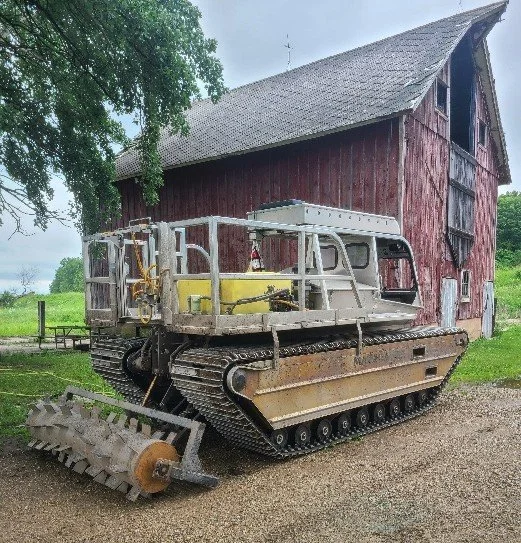
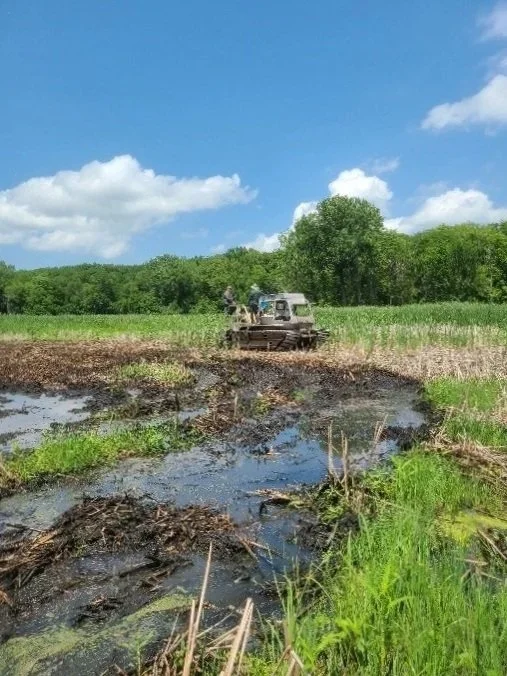
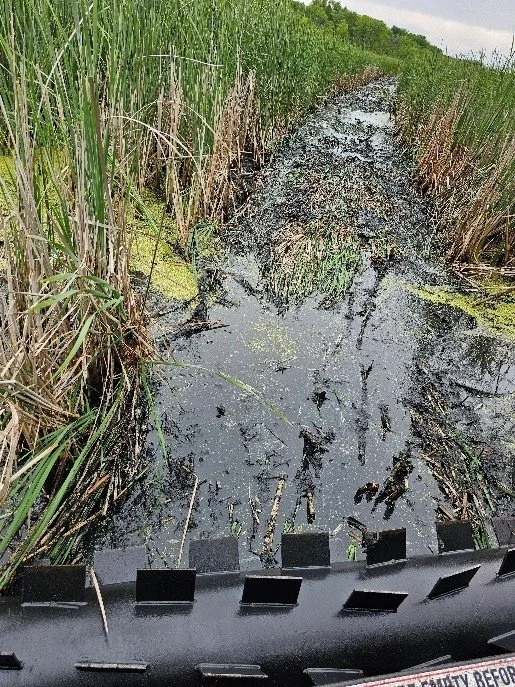
Left to right: The Marsh Master; a path of cattails in the hemi-marsh that have been rolled with the marsh master; the marsh master behind an area of rolled cattails. Areas of exposed mud were hand seeded shortly after. Credit Claire Morrical and Justin Seibert.
Site 2: The Dore Seep
At the edge of Hennepin Lake is a remnant seep where spring water from the surrounding watershed hurries through narrow runs and into the Refuge’s lake. The remnant Dore Seep is a boon to the wetlands water quality, and home to a great community of species, including the state endangered yellow monkeyflower. Designated as an Illinois Nature Preserve, it’s no surprise that managing the seep requires a gentler approach than the Marsh Master.
What makes this tricky is that the Dore Seep sits at the edge of a stronghold of cattails, meaning that we need a gentle approach that hits hard. The most careful way to apply herbicide is hand-wicking. We put on cotton gloves over chemical resistant gloves, soak them in herbicide, and run our hands over every single cattail blade to coat them with herbicide. Every. Single. Blade. Even in a smaller area like the seep, that is a big undertaking. To top this tediousness off, the best time to kill cattails is during the hottest time of year when humidity is off the charts. Fortunately, herbicide isn’t our only tool – enter the brush-cutter.
Remember that many cattail stems make up a very big organism that shares resources among all of these shoots. And even plants must use resources strategically. It takes energy and nutrients to grow a new shoot. If many shoots are cut, maybe it’s not worth the resources to regrow all of those shoots. And maybe you don’t need to invest in creating reproductive structures that won’t be ready until late in the season. Maybe you just focus on putting up a few shoots to photosynthesize and pull the rest of your resources back to the center. A regroup, if you will.
Repeat that a couple of times and you’ve significantly reduced the number of cattail shoots you need to hand wick. And if we repeat this year after year, we can slowly push the cattails back. Once again, we can follow up by planting other beneficial wetland plants in the cattail’s place. This year, we planted over 2,000 Common lake sedges (Carex lacustris).
Conservation is a messy science, so we’re always playing with techniques to make our work easier and more effective, reducing herbicide, time, and unintended impacts. Right now, in addition to hand-wicking after the cattails re-sprout, we’re experimenting with painting the stumps of cut cattails with herbicide. This requires less herbicide and allows us to treat cattails immediately after cutting. We’re still assessing how effective this is compared to our typical technique, but both seem to have an impact on the cattails.
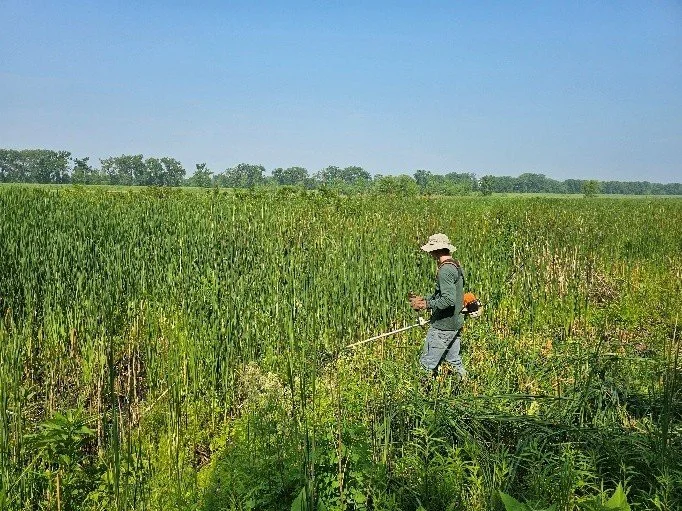
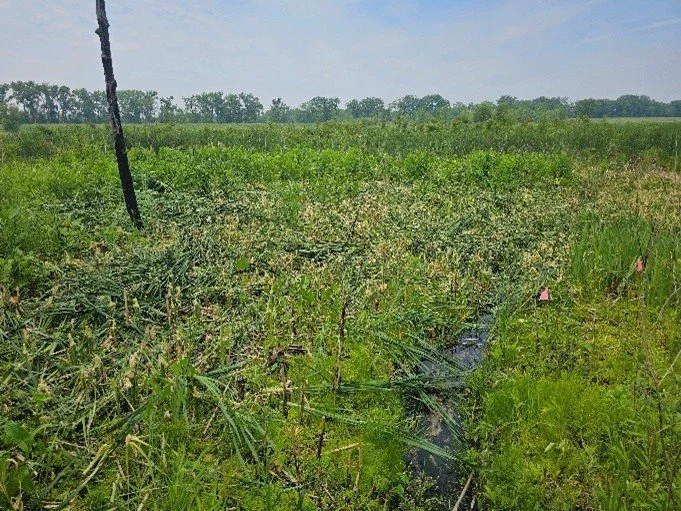
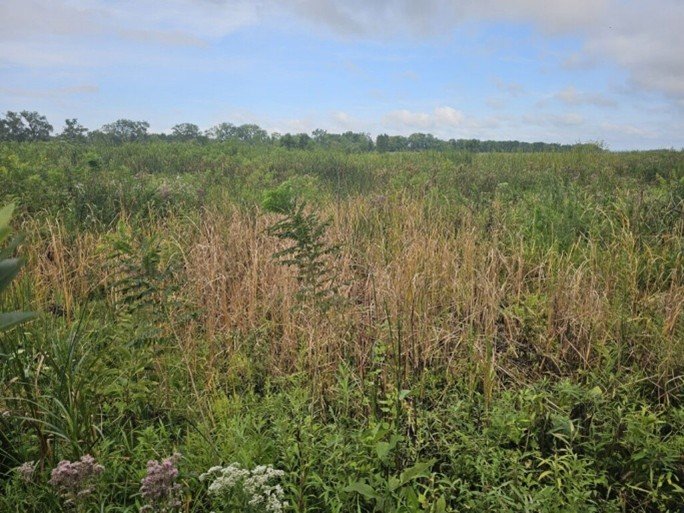
Left to right: Restoration Specialist Bret brush-cuts in front of a wall of cattails; the seep is much more open after the cattails are brush cut; about a week after the cattail regrowth has been hand wicked, they turn brown and die off. Credit Claire Morrical and Justin Seibert.
Conclusion
Now, we don’t expect cattails to disappear overnight, or even in just one or two years. And once cattails have been cleared, we must continue working to keep them from moving back in. Restoration and land stewardship is a slow and repetitive process. But you learn to notice even little signs of progress. For our current crew of restoration specialists at the Refuge, this is our first year and we haven’t yet seen the full impact of this summer’s treatment. But even now we can see a big difference between the area that last year’s crew treated, the areas that we treated, and untreated areas in the wetlands.
And it’s easy to tell that Justin, the Refuge Site Manager, is excited about the progress! I look forward to seeing the hemi-marsh and the seep next year, and to continuing to hone our approach to managing cattails at the Sue and Wes Dixon Waterfowl Refuge.